
THE UK MEASUREMENT REFERENCE
Understand
the reading.
Know the limits.
Clear explanations for HVAC, refrigeration and heat-pump engineers. Understand an unexpected vacuum reading and identify what to check before connecting an instrument.
PRESSURE / VACUUM / TEMPERATURE / LEAK DETECTION
START WITH THE JOB QUESTION
What do you need to establish?
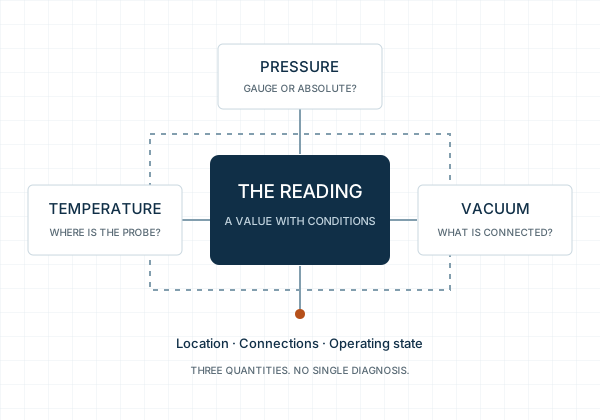
A useful measurement keeps the tool, connection and conditions in view.
A reading looks wrong
Pressure, temperature or a rising vacuum: understand the setup before naming the fault.
Find your starting point ↗02Will these parts connect?
Identify both ends, seals and accessory requirements. Keep unknowns visible.
Find your starting point ↗03Which instrument fits the task?
Check documented capabilities, software claims and measurement limits.
Find your starting point ↗WHEN THE VACUUM READING RISES
The system is only
part of the picture.
Hoses, seals, small isolated volumes and sensor condition can change what you see. Separate the observation from the explanation before calling it a leak.
Explore the possible causes ↗Define the boundaryWhat remains connected to the gauge?
Keep the conditionsWhere, when and under what operating state?
Check the evidenceWhat does this result leave unresolved?
MEASUREMENT EXPLAINED
Better questions. More useful readings.
Pressure, vacuum and temperature: what does the reading mean?
First identify what the instrument measures, its reference and the measurement point. Gauge pressure, absolute vacuum and pipe temperature answer different questions. A pressure reading alone cannot establish refrigerant charge, and a small display increment does not establish measurement accuracy.
Read the reference Measurement guidesRefrigerant leak detector types: capability and limits
Choose a method for the refrigerant, environment and question being asked. Refrigerant-sensitive electronic detectors, ultrasonic instruments and approved bubble solutions detect different effects. A sensitivity figure or a refrigerant-table entry does not establish suitability for every refrigerant or approval for a flammable atmosphere.
Read the reference Measurement guidesInstrument checks are not the same as calibration
Zeroing adjusts a reference point; a function check shows a response; a comparison shows agreement or disagreement. Calibration establishes the relationship to a reference under stated conditions and reports measurement results and uncertainty. None of these automatically proves that a tool is suitable for every job.
Read the referenceMODEL AND CONNECTION REFERENCE
Check the model.
Check the connection.
Elitech VGW-mini and LMG-10: manufacturer specifications, connection requirements and the details still to confirm.
Read the instrument profiles →VGW-miniVacuum measurement / App features advertisedKit contents and software versions unconfirmed
LMG-10Pressure & temperature / digital manifoldLMG-10W features are not inherited
SOURCES, WITH THEIR LIMITS
What supports this reference?
Technician explanations, exact-model manufacturer documentation and current UK official guidance. Each guide identifies the evidence behind its claims. The instrument profiles are based on documentation; we have not physically tested the featured models.
- HVAC School: testing the leak rate on a micron gauge ↗
US technician education with commercial relationships; external observations. Linked video not independently reviewed.
- ElitechEU: manifold gauge comparison table ↗
Manufacturer comparison; use the LMG-10 column, not a neighbouring model.
- GOV.UK: qualifications to work with F gas ↗
Current official guidance; follow its territorial scope and activity-specific requirements.
- DAERA: fluorinated greenhouse gases in Northern Ireland ↗
Northern Ireland authority; consult the separate NI regime and linked current guidance.