
A rising vacuum reading is an observation, not a diagnosis of a refrigerant leak. Gas entering through a leak, moisture or material outgassing, trapped volumes, changing temperature and the measurement assembly itself can all affect pressure. Interpretation needs the setup, volume, time and sensor condition.
Source-based explanationStart with the measurement boundary
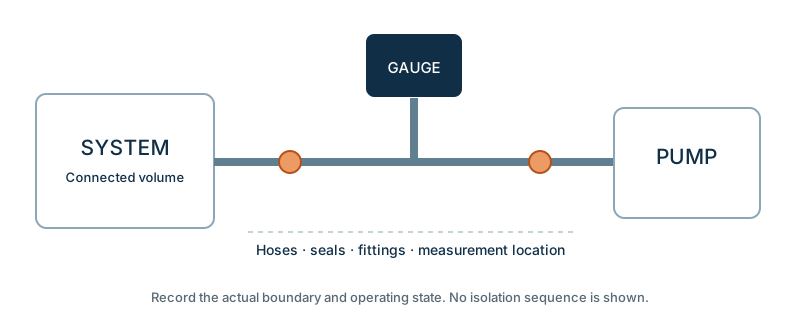
Record what remains connected during the observation and where the gauge is located. A tiny isolated gauge-and-fitting volume behaves differently from a complete system. HVAC School describes how the same small gas ingress can produce a conspicuous rise in a small volume. That external example is not a measurement of your gauge.
Keep several explanations open
| Possible contributor | What to record or compare | What it does not prove |
|---|---|---|
| System leakage | Observed trend with an identified system boundary | A rise alone does not locate a leak |
| Moisture or outgassing | Time, ambient conditions and equipment history | A pressure curve alone does not identify a particular contaminant |
| Hose, seal or fitting | Exact assembly and a separately assessed reference assembly | A passing system check does not qualify every hose |
| Measurement position | Gauge position and whether gas is still flowing | The pump reading is not necessarily the system reading |
| Sensor condition | Recent exposure, cleaning and manufacturer checks | An unstable reading does not by itself prove sensor failure |
Why the shape of a curve is not enough
A levelling trend may be consistent with some outgassing processes, but temperature changes, connected volume and multiple gas sources complicate interpretation. A continuing rise also has several possible causes. Keep raw time-stamped values; do not label a curve “leak” or “moisture” solely because it resembles an illustration.
The blank record can hold repeated observations using a shared record ID. The instrument’s own data export is useful supplementary evidence if its units, timestamps and sample interval are preserved.
Check the gauge on its own terms
Use only the model’s documented checking and cleaning method. Solvents, positive-pressure exposure or a method shown for another sensor may damage the instrument. A comparison with a known reference can reveal disagreement, but does not establish which instrument is wrong without a suitable reference and stated uncertainty.
Any change to a live refrigerant circuit requires the appropriate competence, equipment and system-specific procedure. This page explains possible measurement effects; it is not a circuit isolation or evacuation procedure.
Sources and limits
References checked on . Manufacturer declarations and other authors’ observations are not our physical test results.
- HVAC School: testing the leak rate on a micron gauge ↗
US technician education with commercial relationships; external observations. Linked video not independently reviewed.
- AC Service Tech: 40 vacuum tips ↗
US educator and commercial tool publisher. US regulatory references and suggested targets are not UK requirements.
- HVAC School: micron gauges gone wild ↗
External sensor-contamination examples; cleaning advice is not universal across models.
Keep the evidence with the reading
Use the blank field record for conditions, instruments, connection details and repeated readings. See how we assess evidence and our commercial relationship.