Elitech’s comparison table describes the LMG-10 as a two-valve digital manifold with pressure and temperature measurement. Its vacuum entry is ATM/101 kPa, not the dedicated micron range shown for other models. The same column marks App control unavailable. LMG-10W is a different model and its features must not be imported into this profile.
Manufacturer documentation · not hands-on tested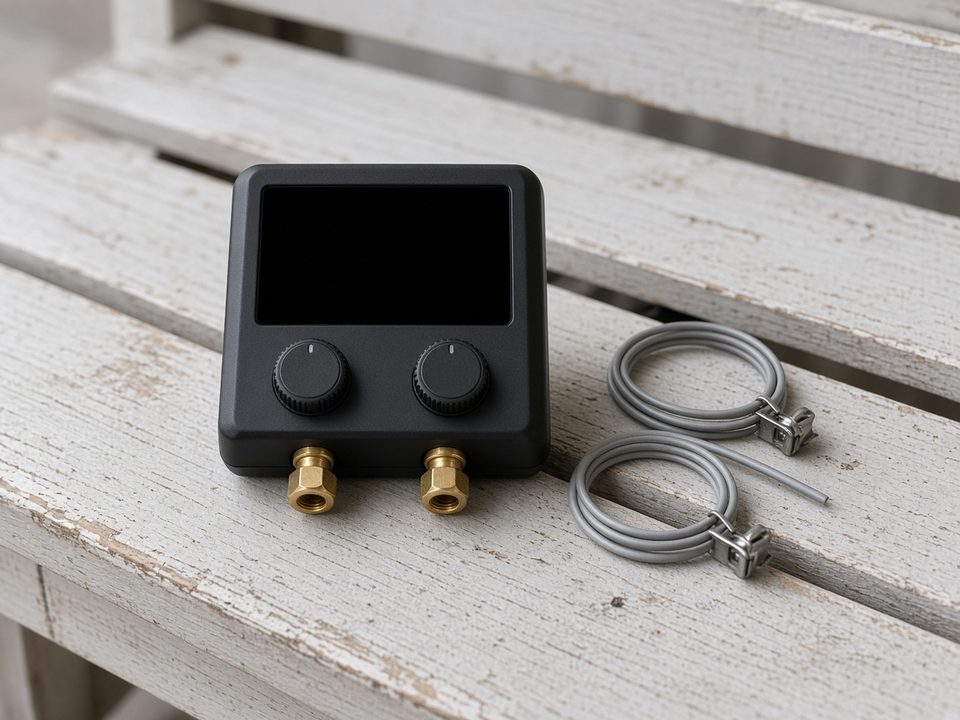
What does Elitech document for the LMG-10?
Elitech’s comparison table describes the LMG-10 as a two-valve manifold for pressure and temperature measurement. It lists full-scale pressure accuracy, a refrigerant menu and a vacuum entry expressed as ATM/101 kPa. Those are manufacturer declarations, not our measurements, and they do not establish the capabilities of the separate LMG-10W model.
| LMG-10 field | Published value | Qualification |
|---|---|---|
| Pressure range | −14.5 to 800 psi | Instrument range, not a universal circuit test pressure |
| Pressure accuracy | ±0.5% FS | Full-scale claim; not ±0.5% of each displayed reading |
| Temperature range / accuracy | −40 to 150 °C / ±0.5 °C | Table claims; probe and operating conditions need the exact manual |
| Temperature lead length | 2 m | Does not establish the contents of every sales kit |
| Vacuum entry | ATM/101 kPa; ±0.5% FS | Not a documented dedicated micron sensor capability |
| Refrigerant entries | 88 in the comparison table | A P–T list is not a list of permitted media or flammable-use approvals |
| Valve ways / power | 2 / three AA cells | Manufacturer comparison, not our inspection |
| BLE / App control | “/” / “×” in this model’s column | No wireless/App capability established for LMG-10 |
What can these values not establish?
A pressure reading is one input into system assessment. Refrigerant identity, operating state, corresponding temperatures and equipment instructions determine whether derived values are meaningful. An 88-refrigerant menu cannot establish a hose’s working-pressure rating, wetted-material suitability or safe-use approval for flammable refrigerants.
The negative-pressure display must not be substituted for a dedicated vacuum gauge where the equipment procedure calls for an absolute deep-vacuum reading. Neighbouring EMG-model micron specifications do not apply to the LMG-10.
Which connections and accessories are still to confirm?
The reviewed comparison column does not give enough detail to establish every pressure port’s gender, sealing arrangement, temperature-probe connector, current kit contents or compatible adapter part numbers. These remain unknown in our register. Obtain the exact model manual and UK kit list before specifying an assembly.
How is the LMG-10 different from the LMG-10W?
Keep the complete model marking, suffix, hardware revision and firmware with the record. A retailer title, an App screenshot or a similarly named wireless model is not evidence for the plain LMG-10. This profile covers the plain LMG-10 only and is based on manufacturer documentation.
What is the calibration and evidence status?
HVAC Leak Check has not tested this model’s measurement accuracy or repeatability. Before a job that depends on accuracy, confirm instrument condition, appropriate reference checks and any required calibration evidence. The table is a record of manufacturer claims checked on the date below.
Which sources support this reference, and what are their limits?
These sources support the terminology, declared capabilities and attributed observations discussed in this reference. Manufacturer declarations and other authors’ observations are not our physical test results. Check the exact model and the source’s stated conditions before applying a claim; the references were consulted on .
- ElitechEU: manifold gauge comparison table ↗
Manufacturer comparison; use the LMG-10 column, not a neighbouring model.
- AC Service Tech: why pressure alone does not establish charge ↗
US technical education; system-specific commissioning instructions remain necessary.
- HVAC School: negative superheat and tool checks ↗
US technical explanation; not UK regulatory guidance.
What should stay with the reading?
A useful measurement record preserves the conditions, instruments, connection details and original reading, then adds any repeated observation or retest. Use the blank field record to keep those details together. See how we assess evidence and our commercial relationship when judging the scope of a published conclusion.