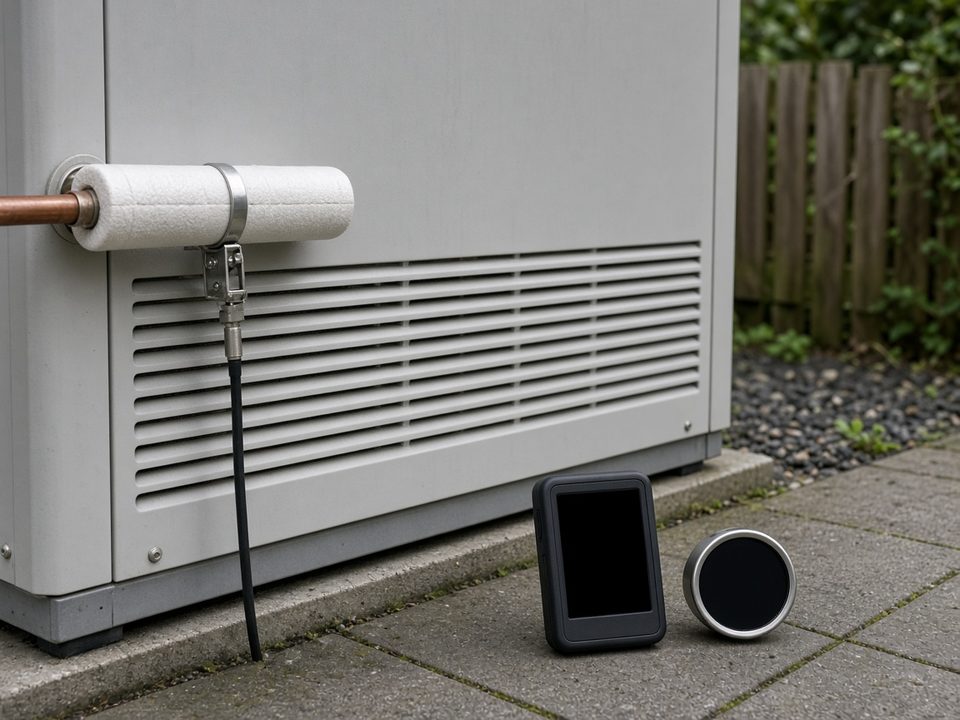
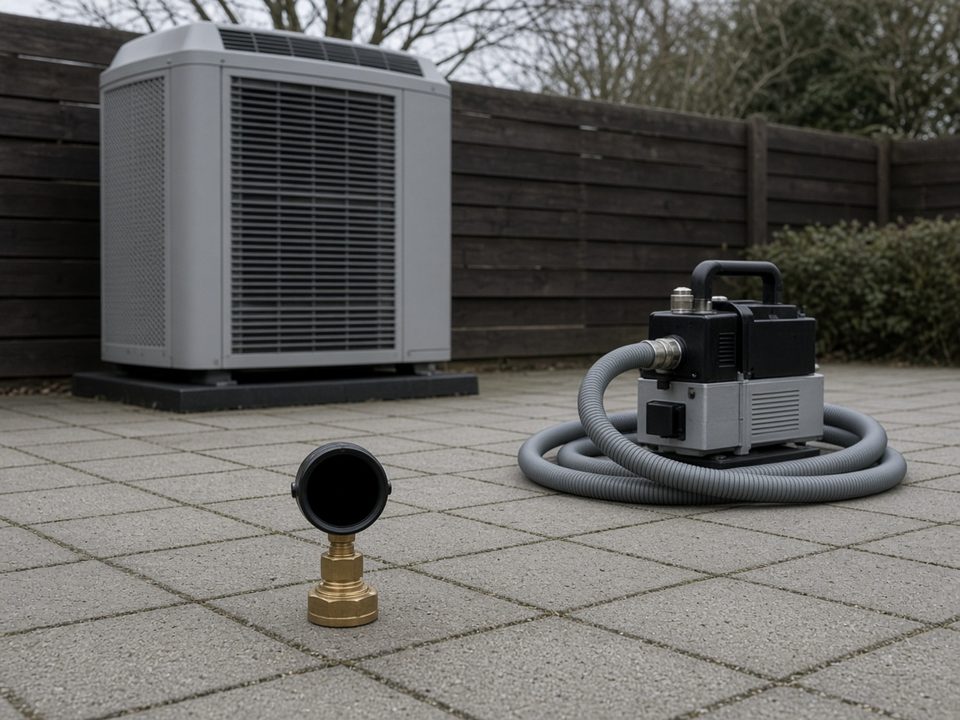
Start with the measurement decision, then choose the instrument and every component needed to obtain a defensible reading. A smaller kit can be complete for a limited task; a larger wireless kit is useful only when its sensors, connections, software and records suit the job. Entry-level does not mean suitable for unsupervised refrigerant work.
Source-based explanation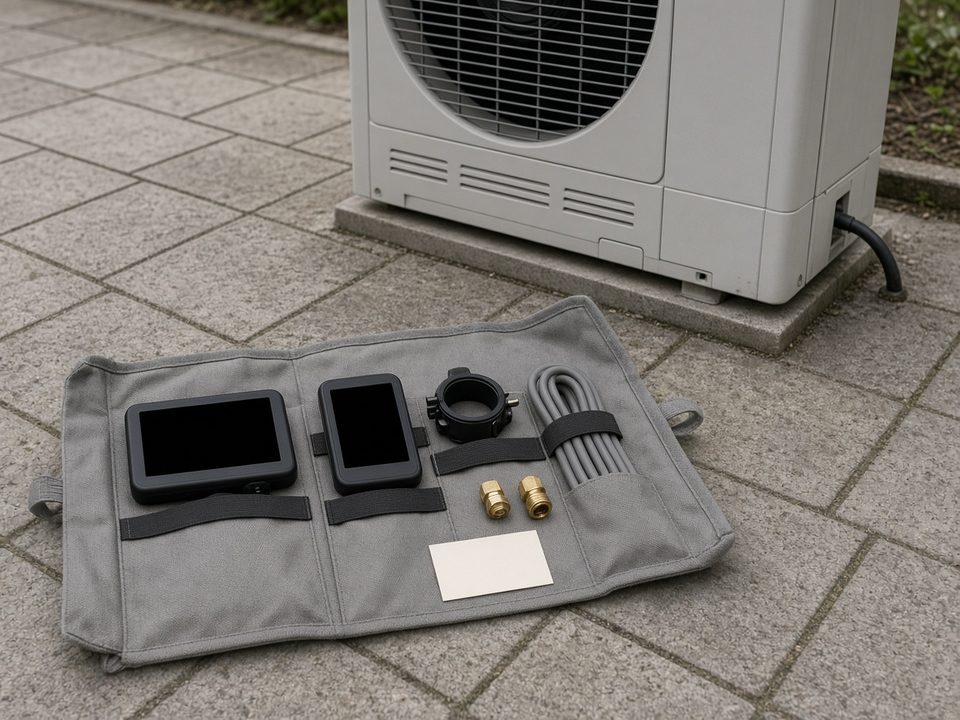
Which tools belong together for each measurement task?
Choose a combination that measures the quantities needed for the task and includes suitable connections, probes and records. Pressure, evacuation, leak location and wireless surveys need different evidence. More instruments do not automatically make a complete kit; every accessory and software combination must suit the actual equipment and working conditions.
| Task | Focused starting combination | More demanding work / supporting evidence |
|---|---|---|
| Pressure and pipe temperature | Appropriate pressure instrument, compatible rated connections and suitable contact temperature probes | Multiple points, documented uncertainty, synchronised readings and a reference comparison |
| Evacuation observation | A dedicated vacuum gauge with a documented connection assembly | Time-stamped trends, independently assessed connections and known sensor condition |
| Locate a suspected refrigerant leak | Detector documented for the refrigerant and conditions, with its function-check accessories | Complementary permitted method, reference-leak records and repeatable site documentation |
| Wireless survey | Supported probes, correct App and a compatible phone/tablet | Verified firmware/OS combination, exports, time alignment, offline behaviour and retained raw files |
| Air differential pressure (adjunct) | An instrument and tubing intended for the relevant air-pressure range | Known port polarity, zero conditions and a suitable reference; not a refrigerant manifold substitute |
Why are the accessories part of the measurement?
List the hose or adapter’s exact part number, end sizes and genders, seal type, rated pressure and permitted medium. Record whether a valve-core actuator is required and how its suitability is established. The instrument’s own rating cannot qualify a lower-rated hose or an unidentified adapter.
For temperature, confirm the probe connector, sensor type and supported channel. A connector that fits is not proof of the correct electrical sensor characteristic.
What should you check before committing to a wireless ecosystem?
Verify the exact probe against the App’s supported-device list, then record App version, OS version and instrument firmware. Bluetooth availability alone does not establish cross-brand support. Test the needed workflow: pairing, simultaneous channels, time alignment, connection loss, saved files and export units. We have not tested these software workflows.
Elitech’s LMG-10 comparison column does not claim App control. The VGW-mini page advertises an App workflow, but the reviewed documentation does not establish minimum OS versions or interoperability with third-party Apps.
Which official guidance applies to professional refrigerant work?
Great Britain: check the current GOV.UK qualification and leak-check guidance for the activity and equipment. Northern Ireland: check DAERA’s separate F-gas guidance; do not assume the GB regime applies. Instrument ownership or an App report is not evidence of competence or legal compliance. These explanations do not provide charging, pressure-testing or flammable-refrigerant work instructions.
A supervised apprentice can use this reference to prepare a tool and record checklist. Responsibility for live-system procedures and acceptance decisions remains with the appropriately competent person. These combinations are capability checklists, not an approved procurement list or a training qualification.
Which sources support this reference, and what are their limits?
These sources support the terminology, declared capabilities and attributed observations discussed in this reference. Manufacturer declarations and other authors’ observations are not our physical test results. Check the exact model and the source’s stated conditions before applying a claim; the references were consulted on .
- AC Service Tech: task-organised tool reference ↗
Commercial/affiliate tool list; only stationary HVAC and refrigeration content informs this site.
- TruTech Tools: Appion replacement parts ↗
Retailer parts catalogue; part numbers are model-specific, not universal compatibility evidence.
- TruTech Tools: measureQuick reference ↗
Retailer software reference; multi-brand support does not establish support for every model.
- ElitechEU: manifold gauge comparison table ↗
Manufacturer comparison; use the LMG-10 column, not a neighbouring model.
- ElitechEU: VGW-mini product specifications ↗
Manufacturer declaration; options and customer comments are not a verified kit inventory.
- GOV.UK: qualifications to work with F gas ↗
Current official guidance; follow its territorial scope and activity-specific requirements.
- DAERA: fluorinated greenhouse gases in Northern Ireland ↗
Northern Ireland authority; consult the separate NI regime and linked current guidance.
What should stay with the reading?
A useful measurement record preserves the conditions, instruments, connection details and original reading, then adds any repeated observation or retest. Use the blank field record to keep those details together. See how we assess evidence and our commercial relationship when judging the scope of a published conclusion.