
An adapter is a relationship between two identified ends. Record both nominal sizes, male or female form, sealing geometry, valve-core actuation and operating limits. “1/4 SAE” by itself is not a complete connection specification, and a physically matching thread does not prove a pressure-tight or permitted assembly.
Source-based explanationRead the label as the start of the check
Refrigeration fittings are commonly described using nominal SAE flare sizes. The label is not simply the outside diameter of the thread. Service connections described as 1/4 inch and 5/16 inch occur in the trade, but refrigerant name alone does not identify a particular unit’s connection. Use the equipment and accessory drawings to establish the exact thread dimensions and sealing arrangement.
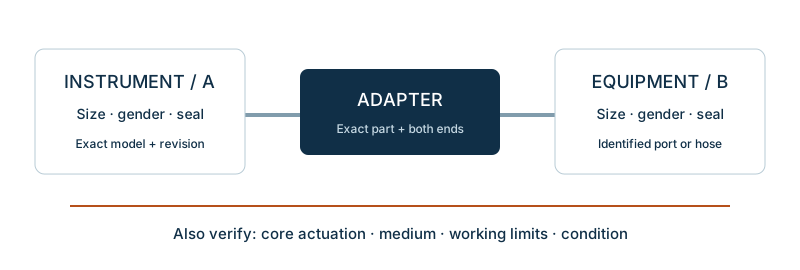
Write the connection in full
| Field | Required information | If missing |
|---|---|---|
| End A: instrument | Exact model/revision, nominal size, gender and sealing face | Unconfirmed; do not infer from a product photograph alone |
| Adapter | Exact part/revision and both end specifications | Do not generalise a family or kit name into compatibility |
| End B: equipment or hose | Identified service port or hose end and seal | Unconfirmed until that particular assembly is documented |
| Core actuation | Whether required; documented actuator design and fit | A threaded connection may fail to open the port |
| Limits | Working pressure, vacuum suitability, medium and temperature | A burst rating is not a working-pressure rating |
| Condition | Seal, seat, actuator and hose inspection state | New or matching parts still need appropriate checks |
VGW-mini: what is known and what is not
The ElitechEU specification says “1/4 SAE”. Customer comments mention a male interface and the absence of a female-to-female connector in their orders. Those comments are useful prompts to check a kit; they do not confirm every current kit’s contents, sealing arrangement or production revision.
Our compatibility register therefore leaves gender, mating equipment and exact adapter part numbers unresolved. A complete connection needs evidence for both mating ends and the adapter.
Avoid the adapter-chain trap
Each added connection introduces another sealing surface and possible restriction or trapped volume. A reading affected by the connection can be mistaken for a system fault. Record the complete assembly rather than only the first adapter, and use the equipment-specific procedure to assess it. Do not improvise sealant, torque or valve manipulation from this schematic.
Sources and limits
References checked on . Manufacturer declarations and other authors’ observations are not our physical test results.
- ElitechEU: VGW-mini product specifications ↗
Manufacturer declaration; options and customer comments are not a verified kit inventory.
- TruTech Tools: Appion replacement parts ↗
Retailer parts catalogue; part numbers are model-specific, not universal compatibility evidence.
- AC Service Tech: 40 vacuum tips ↗
US educator and commercial tool publisher. US regulatory references and suggested targets are not UK requirements.
Keep the evidence with the reading
Use the blank field record for conditions, instruments, connection details and repeated readings. See how we assess evidence and our commercial relationship.